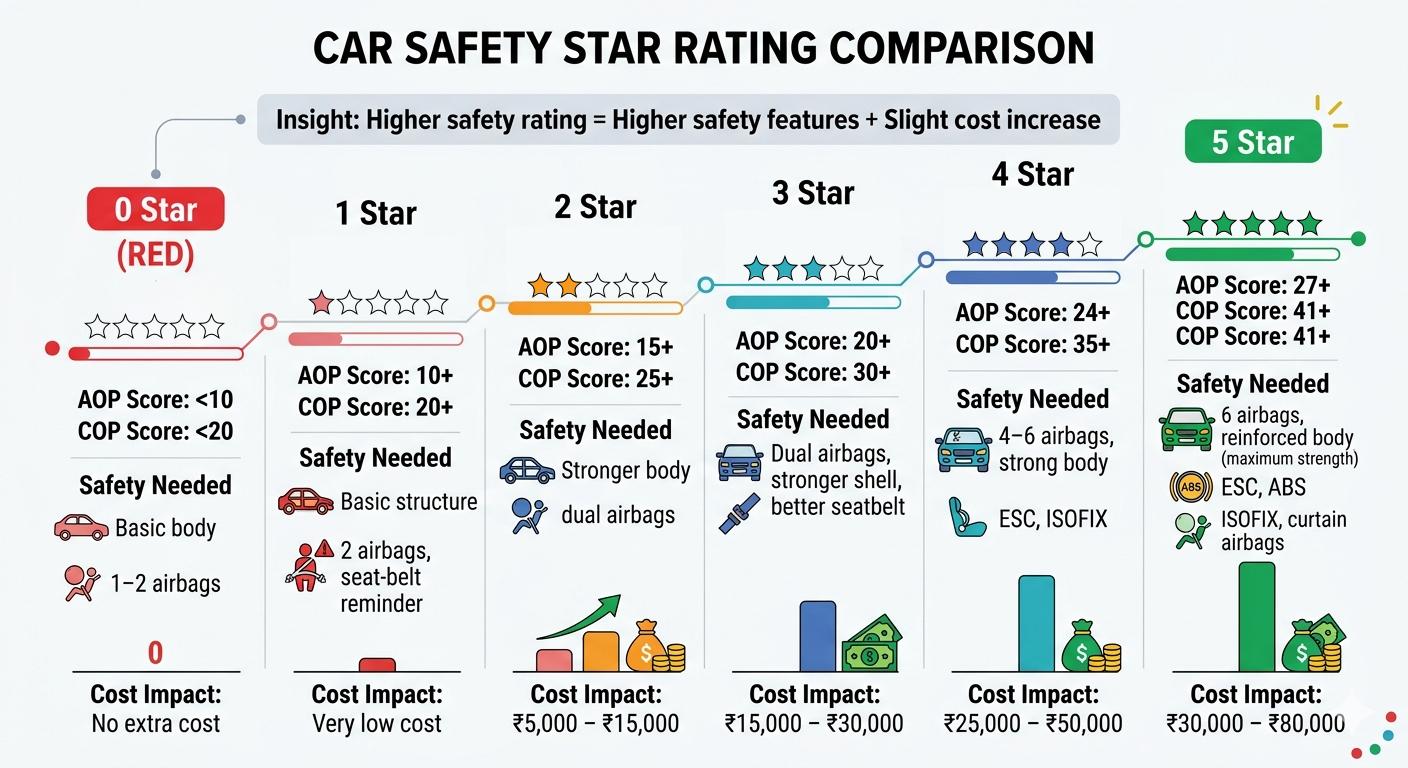
The 5-Star safety rating is the highest safety score given to passenger cars in India based on crash-test performance, occupant protection, and safety features. This rating is provided under Bharat NCAP (New Car Assessment Programme), introduced by the Government of India in October 2023 to improve vehicle safety and reduce road accidents. Under this program, vehicles are tested through frontal crash tests, side-impact tests, adult occupant protection, child occupant protection, and safety-assist feature checks before the final star rating is given. The system helps manufacturers build safer vehicles and allows customers to understand the safety level of cars sold in India.
Crash testing under Bharat NCAP is done only at government-approved centres in India. The main testing agencies are ARAI Pune, ICAT Manesar, and GARC Chennai. These centres perform crash tests and safety evaluation, while the vehicle body, platform, and safety systems are designed and manufactured by automobile companies such as Tata Motors, Mahindra & Mahindra, Maruti Suzuki, and Toyota before testing.
Scoring System and Rating Criteria
Under the current Bharat NCAP system, the rating is based on Adult Occupant Protection (AOP) with a maximum of 32 points and Child Occupant Protection (COP) with a maximum of 49 points. To achieve a 5-Star rating, a vehicle usually needs around 27 or more points in AOP and 41 or more points in COP, along with safety features such as airbags, seat-belt reminders, ABS, and Electronic Stability Control. If the required score is not reached, the manufacturer must improve the vehicle structure and safety equipment and test again. The government does not charge for the rating, but manufacturers spend more to add safety features, which increases vehicle cost.
Cost Impact of Higher Safety Ratings in India
Higher star ratings need stronger body structure, more airbags, and advanced safety systems, which increase manufacturing cost. Vehicles with 0-Star or 1-Star rating usually have basic safety equipment, so the cost is low. For 2-Star and 3-Star ratings, manufacturers need stronger body shell, dual airbags, and better seat-belt systems, which slightly increases cost. For 4-Star rating, cars require extra airbags, reinforced body, ESC, ABS, and ISOFIX mounts, which increases production cost.
For a 5-Star rating, vehicles must have six airbags, strong crash-tested platform, reinforced body panels, ESC, ABS, curtain airbags, and advanced safety electronics. Because of these parts, the manufacturing cost may increase by around ₹30,000 to ₹80,000 compared to basic models. Customers do not pay for the rating directly, but safer cars cost more because they include more safety equipment.
Limitations of the Current Star Rating System
Even though the 5-Star rating improves safety, crash tests are done under controlled conditions and cannot guarantee safety in every real accident. India recorded about 1,77,177 road-accident deaths in 2024, and most accidents happened due to over-speeding, not wearing seat belts, or driver mistakes. Another limitation is that Bharat NCAP ratings apply only to passenger vehicles such as hatchbacks, sedans, SUVs, MPVs, and electric cars, and not to trucks, buses, or three-wheelers.
Future Outlook of 5-Star Rating in India
The Bharat NCAP system started in 2023 and may become stricter after 2026–2027. Future rules may change the scoring system from the current 32 + 49 points to a 100-point evaluation, where vehicles will be checked for crash safety, electronic safety, accident-avoidance technology, and pedestrian protection. A vehicle may need around 70 out of 100 points for 5-Star rating in the future, and the requirement may increase later, making the rating harder to achieve.
The number of crash tests may also increase from three to five tests, including frontal crash, side crash, pole test, rear impact, and pedestrian safety test. These changes are planned because India still records more than 1.7 lakh accident deaths every year. Future safety rules may make six airbags, ESC, strong body structure, and advanced safety systems compulsory, which may increase vehicle cost but will improve passenger safety and overall road safety in India.


%201.png&w=96&q=75)
%201.png&w=96&q=75)
%201.png&w=96&q=75)
%201.png&w=96&q=75)
%201.png&w=96&q=75)