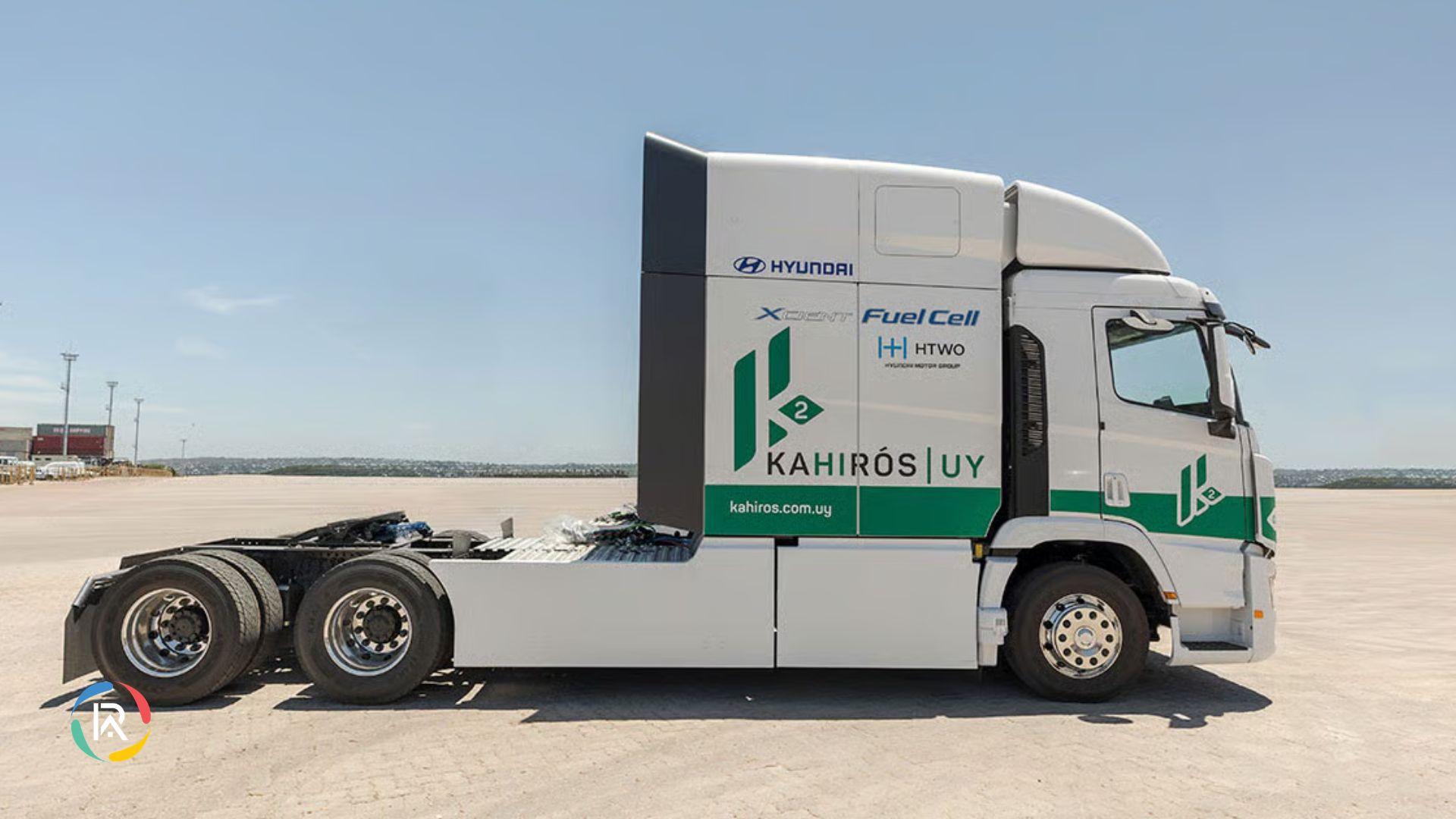
Seoul/ Uruguay- Hyundai Motor Company has announced the deployment of eight XCIENT Fuel Cell Class-8 heavy-duty trucks in Uruguay, marking the first regular fleet operation of hydrogen fuel cell electric heavy-duty trucks in South America. The move strengthens Hyundai’s position in zero tailpipe emissions commercial mobility and supports the decarbonization of freight transport in the region.
The trucks will operate under the Kahirós Project, a local initiative aimed at reducing emissions in Uruguay’s timber logistics sector through the use of green hydrogen. Hyundai is participating in the project alongside Uruguayan consortium partners Fidocar, Fraylog, and Ventus, with financial backing from Santander Group.
The Kahirós Project is focused on producing green hydrogen from renewable sources and using it to power freight transportation. Uruguay’s strong renewable energy base supports this effort, with the country generating 99% of its electricity from renewable sources in 2024, according to the Ministry of Industry, Energy and Mining. The project includes the development of a 4.8 MW solar park and an electrolysis plant capable of producing 77 tons of green hydrogen annually, with operations expected to begin in November 2026.
As part of the initiative, six XCIENT Fuel Cell trucks will serve as the main operating fleet and are expected to cover nearly one million kilometers per year. Hyundai is also supplying two additional tractor units for backup and future service expansion, bringing the total fleet size to eight vehicles.
This deployment makes Uruguay the first country in South America to introduce hydrogen-powered heavy-duty trucks for day-to-day logistics operations rather than pilot demonstrations. The project is expected to help establish both local hydrogen production and refueling infrastructure, creating a foundation for broader clean freight adoption across Central and South America.
To support operations, Hyundai Motor and Fidocar are providing specialized aftersales training for Kahirós personnel, including maintenance practices and vehicle operating procedures.
Mr. Juan Andrés Chick, Project Director at Kahirós, said the initiative represents an important step in the decarbonization of freight transport in Uruguay and could serve as a model for future hydrogen mobility projects both nationally and internationally.
Mr. Airton Cousseau, President and CEO of Hyundai Motor Brazil and Hyundai Motor Central and South America Region, said the XCIENT Fuel Cell trucks provide a lower-carbon alternative for freight transport and will help decarbonize a key part of the paper production supply chain.
Mr. Chul Youn Park, Senior Vice President and Head of Hyundai Motor’s Global Commercial Vehicle and Light Commercial Vehicle Business Division, said the Uruguay deployment expands Hyundai’s clean mobility leadership into South America and reflects the company’s commitment to building a more sustainable freight ecosystem through hydrogen-powered commercial vehicles.
The Hyundai XCIENT Fuel Cell truck is powered by two 90 kW hydrogen fuel cell stacks, delivering a combined output of 180 kW. It is equipped with a 350 kW (469 hp) electric motor producing 2,237 Nm of torque, along with 10 hydrogen tanks offering a total storage capacity of 68 kg. A 72 kWh battery pack supports the system, and the truck can achieve a driving range of up to 720 kilometers under optimal conditions. The Class 8 tractor configuration supports a gross combined weight of up to 82,000 lbs.
The Uruguay deployment adds to Hyundai’s growing global hydrogen commercial vehicle footprint. In North America, 63 XCIENT Fuel Cell trucks have collectively logged around 1.6 million kilometers since entering service in 2023. In Europe, 165 trucks operating across Switzerland, Germany, France, the Netherlands, and Austria have surpassed 20 million kilometers since their launch in Switzerland in 2020.
Through these deployments, Hyundai continues to expand its hydrogen mobility ecosystem. Supporting this strategy is HTWO, Hyundai Motor Group’s hydrogen business platform, which offers end-to-end solutions across the hydrogen value chain and promotes collaboration, partnership, and investment in clean hydrogen transport.


%201.png&w=96&q=75)
%201.png&w=96&q=75)
%201.png&w=96&q=75)
%201.png&w=96&q=75)
%201.png&w=96&q=75)