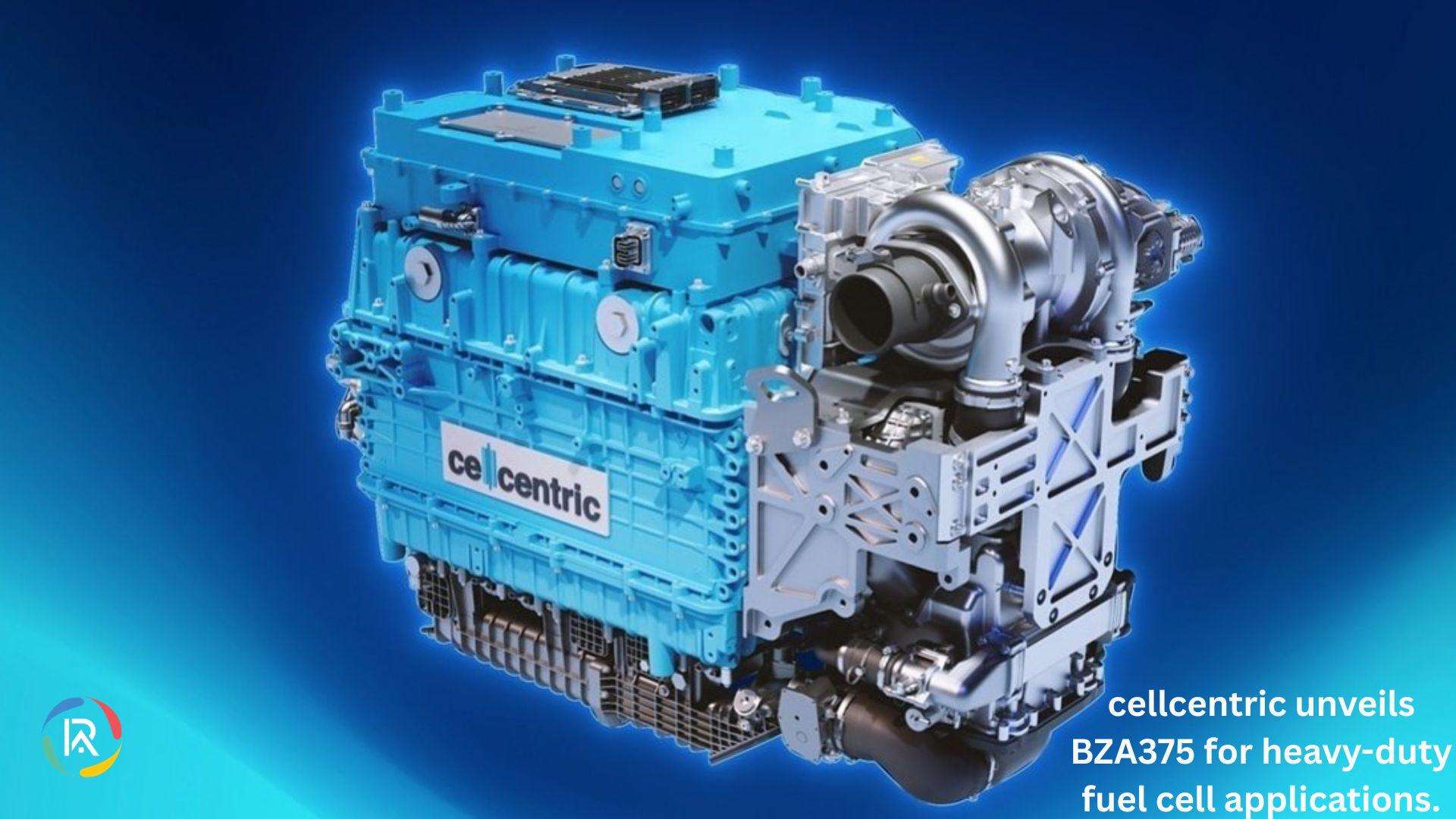
Kirchheim/Teck-Nabern, Germany- cellcentric GmbH & Co. KG., an advanced heavy-duty fuel cell system, has officially introduced its next-generation product under the name BZA375. Previously known as “NextGen” and previewed at Hannover Messe 2026, the new system is now available for testing, validation and further industrial scale-up across a wide range of heavy-duty applications.
Positioned as a Tier 1 supplier focused on heavy-duty trucks and similarly demanding sectors, cellcentric aims to address one of the transport industry’s biggest decarbonization challenges with BZA375: delivering a zero-emission drive technology that is competitive, durable and suitable for some of the world’s toughest operating conditions.
Developed in less than three years, BZA375 reflects a combination of technical innovation, continuous refinement and close attention to customer requirements. Engineered to meet OEM performance and quality standards, the system has been designed to compete with modern diesel engines in heavy-duty use cases.
A central focus of the BZA375 development program was optimizing total cost of ownership (TCO), a critical factor in purchase decisions across heavy-duty markets. According to cellcentric, the new system advances fuel cell technology with a clear emphasis on efficiency, integration and commercial viability.
Mr. Nicholas Loughlan, CTO of cellcentric, said BZA375 has been specifically developed for heavy-duty long-haul trucks while also being well suited to other applications with similar operational needs. He added that cellcentric is structured as an independent Tier 1 supplier and is open to working with any OEMs pursuing decarbonization.
Ms. Karin Rådström, President and CEO of Daimler Truck AG, said battery-electric and hydrogen technologies will play leading roles in the decarbonization of transport. She described the launch of cellcentric’s new fuel cell system as an important milestone that builds on the success of its predecessor while delivering improved efficiency and performance.
Mr. Martin Lundstedt, President and CEO of Volvo Group, said BZA375 provides a blueprint for zero-emission long-haul transportation in the heavy-duty segment and represents a major step forward for logistics providers and the broader decarbonization of the industry.
BZA375 delivers up to 375 kW continuous net power, weighs less than 500 kg, and is engineered to match diesel-like durability. Compared with the earlier BZA150 system, it offers 20% lower fuel consumption, 40% higher power density, and 40% lower system complexity.
The system is aimed mainly at long-haul trucking, where it can support ranges of over 1,000 km with hydrogen consumption of less than 6 kg per 100 km in a fully loaded 40-ton truck. It is also suitable for coaches, rail, mining and stationary power generation.


%201.png&w=96&q=75)
%201.png&w=96&q=75)
%201.png&w=96&q=75)
%201.png&w=96&q=75)
%201.png&w=96&q=75)