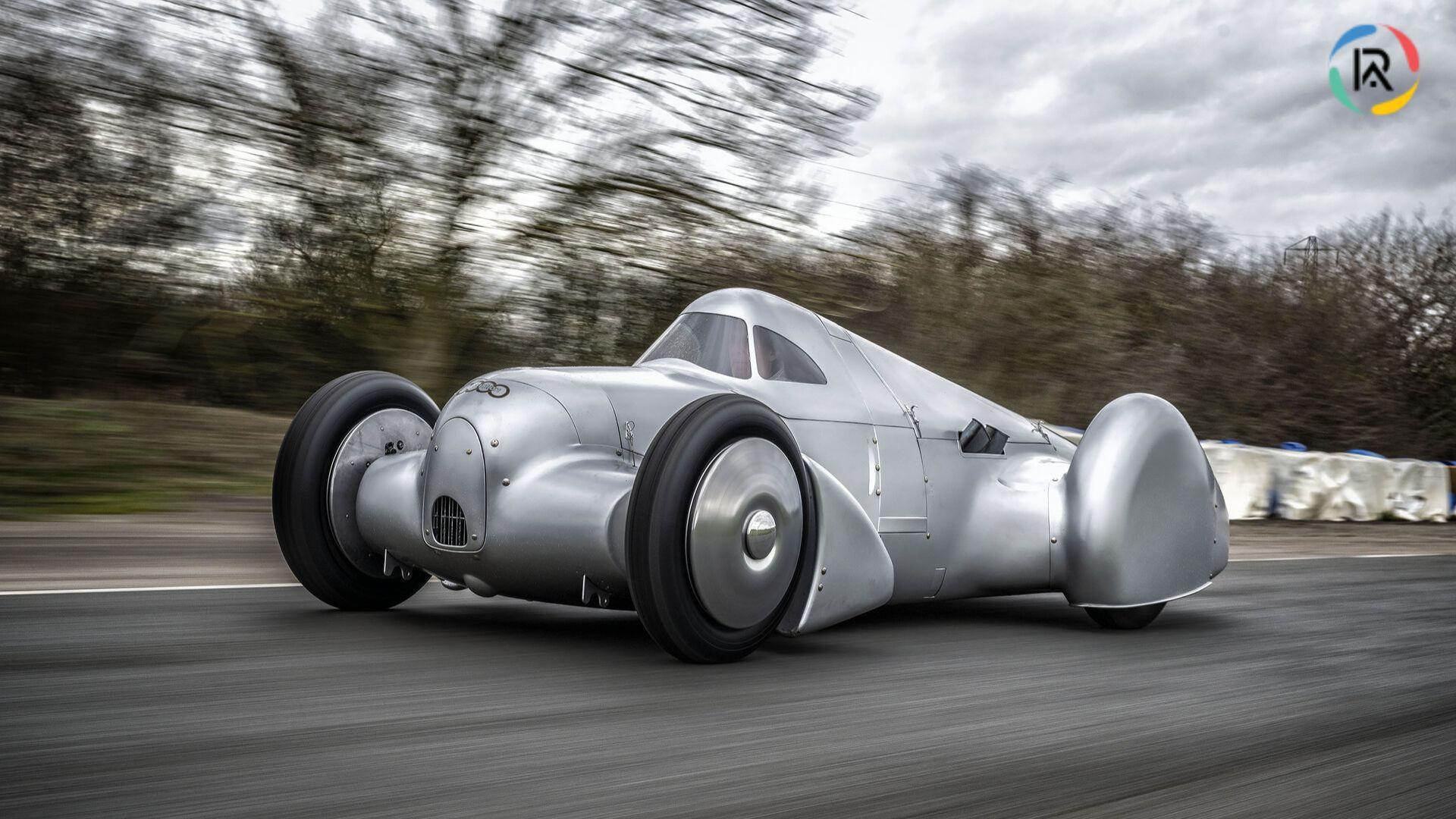
Ingolstadt, Germany - Audi AG, a leading German manufacturer of luxury vehicles, has recreated the Auto Union Lucca, a spectacular record-breaking car that represents the technical innovation of the four rings during the 1930s. The recreated model will be unveiled in early May in Lucca, Italy - the same region where the original car made history on February 15, 1935. Driven by Hans Stuck, the Auto Union Lucca set a flying-start mile record on a straight section of autostrada near Lucca, achieving an average speed of 320.267 km/h and a measured top speed of 326.975 km/h. Completed in spring 2026, the recreated Rennlimousine, meaning “racing sedan,” will now join Audi AG’s legendary Silver Arrow collection.
During the 1930s, speed records became a major symbol of engineering strength and national prestige. Grand Prix racing and record attempts attracted huge attention from both the media and the public. In Germany, competition intensified between major brands, drivers and technologies, including Auto Union and Mercedes-Benz. Auto Union AG, formed in 1932 through the merger of Audi, DKW, Horch and Wanderer, entered Grand Prix racing in 1934 with the 295 PS Auto Union Type A under the new 750-kilogram formula. That same year, Auto Union also achieved multiple world speed records with racing driver Hans Stuck.
After Mercedes-Benz driver Rudolf Caracciola set new international records in late 1934, Auto Union began developing an improved record car for the 1935 season. Engineers used wind tunnel testing at the Berlin-Adlershof Aeronautical Research Institute to refine the vehicle’s aerodynamics, first testing an open version and then a closed-cockpit design. This approach was considered a pioneering step in European racing car development.
The Auto Union Lucca featured a highly aerodynamic body, polished and clear-lacquered surfaces, wheel covers, rear air intakes, upward-facing exhaust outlets and a streamlined rear fin. It was powered by an early 1935 16-cylinder engine with around 5.0 liters of displacement and 343 PS. While its chassis and suspension were based on the 1934 racing car, its extended teardrop-shaped body and functional aerodynamic design gave it a unique appearance. These engineering changes created a powerful visual identity, making the Auto Union Lucca one of the most distinctive high-speed racing cars of its era.


%201.png&w=96&q=75)
%201.png&w=96&q=75)
%201.png&w=96&q=75)
%201.png&w=96&q=75)
%201.png&w=96&q=75)