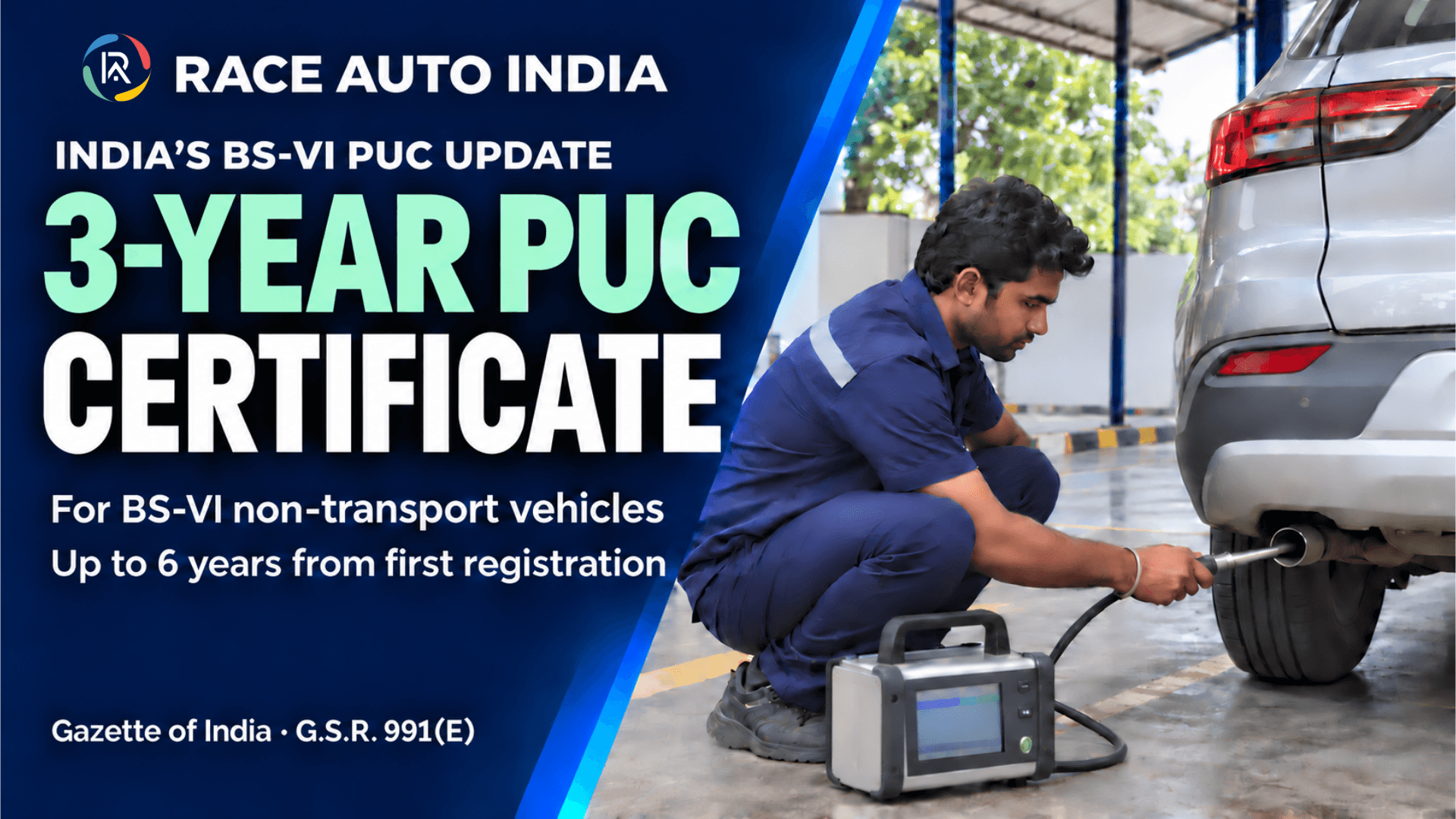
New Delhi,— India has revised the validity of Pollution Under Control (PUC) certificates, giving owners of newer BS-VI private vehicles more time between emissions tests. Under the new rules, BS-VI vehicles registered for non-transport use qualify for a three-year PUC certificate if they are up to six years old. BS-VI vehicles registered for transport use qualify for a two-year certificate in the same age bracket. In both cases, the vehicle’s age is measured from its date of first registration.
The Ministry of Road Transport and Highways introduced the revised schedule through notification G.S.R. 991(E), which amends Rule 115 of the Central Motor Vehicles Rules, 1989. The amendment took effect upon publication in the Official Gazette. The ministry said the changes aim to reduce the compliance burden for owners of newer vehicles while continuing to monitor emissions from vehicles already on the road.
The registration category matters for owners of vehicles that may look identical but serve different purposes. For example, a four-year-old BS-VI car registered for private use falls under the three-year schedule, while a four-year-old BS-VI car registered as a taxi falls under the two-year schedule. For fleet operators, the first registration date of each vehicle determines which age bracket applies when planning renewals.
Once a BS-VI vehicle is more than six years old and up to 10 years old, the PUC certificate is valid for one year, whether the vehicle is registered for private or transport use. For BS-VI vehicles over 10 years old, validity drops to six months. The rules specify six-month validity for BS-IV vehicles and three-month validity for vehicles meeting BS-I, BS-II or BS-III emission standards.
Owners who already hold a PUC certificate issued before the amendment should follow the expiry date on that certificate. The revised validity applies at the first renewal after the amendment takes effect. When renewal takes place within the 10 days before the current certificate expires, the renewed certificate starts on the existing expiry date. If the owner renews after expiry, the new certificate takes effect on the renewal date.
Before scheduling the next test, owners can check the Bharat Stage emission standard, the first registration date and the registered vehicle category in their vehicle records. The amendment still requires vehicles to carry a valid PUC certificate issued or renewed by an agency authorised by the state government and to produce it when requested by an authorised officer